
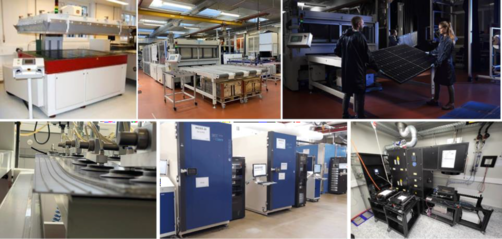
CSEM Module Lamination + Reliability Testing offers external users under Ready-PV a full pipeline for encapsulating, stress-testing, and characterizing emerging PV devices.
A membrane laminator encapsulates single-junction or tandem cells (2, 3, or 4-terminal), cell strings, single-cell laminates, or full modules—with lamination materials and process parameters already validated for perovskite single-junction and perovskite/silicon tandem devices.
Reliability testing covers the full range of IEC 61215 stress conditions: damp-heat, thermal cycling, humidity-freeze, UV exposure, hot-spot and PID testing, creep and mechanical stress, bypass-diode evaluation, and fire testing.
Characterization tools available before and after stress testing include dark/illuminated I-V, spectral response (EQE), photoluminescence and electroluminescence imaging/spectroscopy, Suns-Voc, dark lock-in thermography, X-ray diffraction, UV-Vis-NIR spectroscopy, confocal microscopy, and SEM.
Together, this suite lets users encapsulate their own devices, quantify cell-to-module losses, and pinpoint failure modes under real-world environmental stressors.