
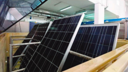
ENEA offers the scientific community access to an integrated suite of equipment for encapsulating photovoltaic modules and evaluating their durability under accelerated ageing.
Available services include: ageing tests on encapsulant materials with pre/post chemical-physical and thermal characterization; fabrication of prototype PV modules using different encapsulants; electrical and optical characterization of modules; and module ageing tests with subsequent electrical/optical assessment.
Climatic chambers cover a range of stress conditions: an ACS Angelantoni chamber for damp-heat testing (200 L, samples up to 50×50 cm); a UV 3000 Angelantoni chamber for UV-accelerated weathering (2 m³, four 2000 W metal-halide lamps, up to +60 °C/60% RH, accommodating commercial modules up to 1.5×1 m); and an Atlas UV Test chamber combining UV-light and condensation ageing (eight fluorescent lamps, 35–80 °C, rain simulation, up to 56 small samples or 4 medium samples).
Module fabrication relies on a RISE Technology CORE 1 semi-automatic laminator with thermal/pressure-cycle control, producing mini-modules up to 500×500 mm across multiple stored programs.
Characterization techniques for encapsulants before and after ageing include UV-Vis transmission spectroscopy, DSC, TGA, yellowing-index measurement, ATR-FTIR, Raman spectroscopy, XRD, SEM, and J-V electrical testing.
The facility supports active industry collaboration—including an ongoing research contract with LyondellBasell on new encapsulant polymers—and has hosted multiple PhD researchers.