
Description
- Single point of access to IPVF’s AI-driven analysis and physics-based modelling expertise for perovskite and tandem PV performance, degradation and reliability.
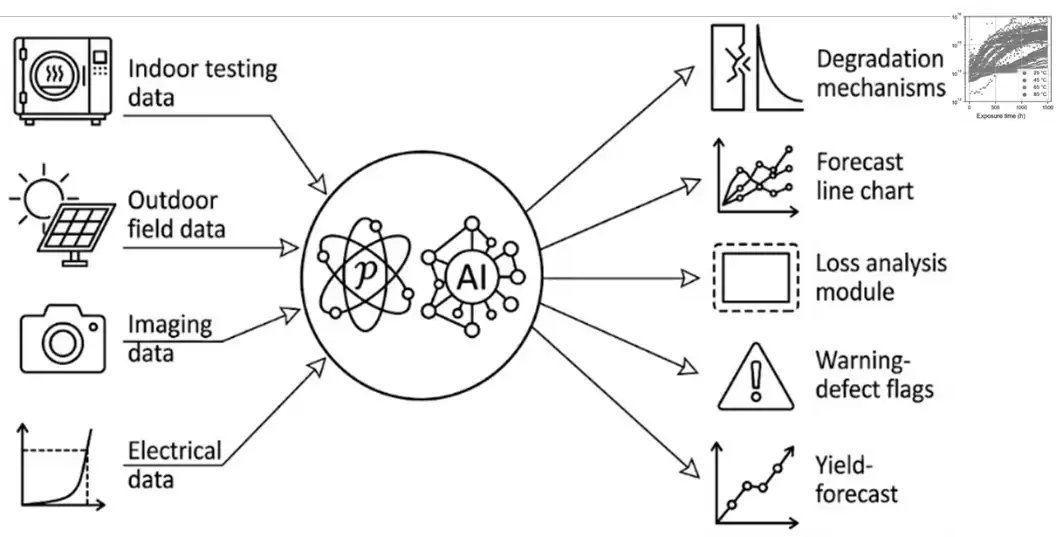
- Covers indoor/outdoor degradation-mechanism comparison, meteorological stress-factor analysis and forecasting, coupling AI modeling and data from multi-technique characterization analysis such as IV and imaging loss diagnostics, and failure/defect detection.
- Applies to indoor and outdoor data supplied by the requester or obtained through complementary characterization infrastructures (IPVF or partner facilities).
This infrastructure gives access to IPVF’s full AI-driven analysis and physics-based modelling capability for next-generation PV technologies, exposed here as a single entry point rather than as separate equipment-specific sheets. It covers the full chain from raw indoor/outdoor characterization data to actionable diagnostics, forecasts and reliability indicators, applying hybrid physics-informed AI methods throughout.
On the degradation side, the service compares indoor accelerated-ageing data with outdoor field data to assess whether indoor protocols are representative of real-world degradation mechanisms, computes a standard set of degradation indicators and develops correlation models projecting outdoor field degradation from indoor results. On the outdoor side, it attributes performance and degradation trends to specific meteorological stress factors and forecasts their future evolution, with explainable-AI attribution tracing every conclusion back to its underlying driver.
On the diagnostics side, the service develops loss analysis coupling operational data with physics/AI models for continuous state-of-health estimation; performs AI-coupled analysis of multi-technique characterization data (imaging and electrical) across cell, and module scales; extracts IV/pseudo-IV, UV-vis, EQE, and imaging techniques (such as EL/PL) loss parameters, including sub-cell-resolved diagnostics for tandems; and detects and classifies electrical and visual failure/defect signatures. On the yield side, it predicts perovskite and tandem energy yield under realistic climatic and spectral conditions, optionally combined with degradation trajectories for long-term, degradation-aware forecasts.
Services currently offered by the infrastructure
Degradation-mechanism and indoor/outdoor representativeness analysis, with standard degradation indicators and correlation modelling.
Meteorological stress-factor attribution, performance/degradation forecasting and explainable-AI attribution.
Loss analysis for continuous state-of-health diagnostics, via multi-technique characterization data coupled to AI models, across cell-to-system scales.
Such as IV/pseudo-IV (and other characterization techniques EL/PL, EQE, etc) loss analysis and diagnostics, including sub-cell-resolved tandem diagnostics.
Failure and defect detection combining electrical and imaging signals.
Modality of access
- Single entry point: the requester describes the research or reliability question, and IPVF scopes which of the analysis capabilities above apply.
- Access is data-driven throughout: indoor/outdoor datasets are supplied by the requester or sourced via the experimental infra (for ex IPVF).
Support offered
- Initial scoping discussion to map a research or reliability question onto the relevant analysis capability (or combination of capabilities) within this infrastructure.
- Guidance on data requirements and, where needed, coordination with a characterization infra to source missing indoor/outdoor data.
- Joint interpretation of results with the IPVF scientific team.
Contact / Expertise
IPVF AI-Driven and physical modeling Performance & Degradation Analysis.