Available Facilities
-
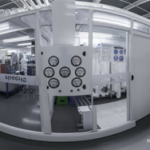
Indoor PV Characterization & Reliability Facility – Swansea University
Indoor testing
- Dedicated platform for performance, stability, and degradation testing of photovoltaic devices and modules under fully controlled environmental conditions
- Co-located with roll-to-roll (R2R) and sheet-to-sheet (S2S) scale-up lines, enabling direct feedback between manufacturing, characterization, and reliability assessment
- Solar Simulators & Light Sources
-
- Multiple Class AAA solar simulators (xenon arc) for standard device and module performance evaluation
- LED-based G2V Sunbrick systems with spectral tuning capability
- Measurements up to 50 × 50 cm
- Integrated MPPT tracking or open-circuit operation
- Temperature/humidity control via dedicated environmental chambers (for small-area devices)
- Sulphur plasma light source (Solixon)
- Atlas Suntest system (open circuit only) — long-term exposure capability
- Fully calibrated low-light testing system, developed in collaboration with NPL (National Physical Laboratory)
- Environmental Stress Testing
-
- Dark weathering chambers (mini-module up to 50 × 50 cm capacity)
- Damp-heat
- Thermal cycling
- Humidity-freeze (cell only)
- UV exposure
- Salt-spray corrosion testing
- Lamination
-
- Large-area vacuum lamination
- Butyl rubber edge sealing, for glass/glass or glass/polymer module formats
Optoelectronic Characterization (pre- and post-stress)
- TRPL (time-resolved photoluminescence)
- PL (photoluminescence)
- EL (electroluminescence)
- LBIC mapping (light beam induced current)
- Additional Techniques
-
- IMPS/IMVS (intensity-modulated photocurrent/photovoltage spectroscopy)
- Materials analysis:
- XPS/UPS (including mapping)
- XRD (X-ray diffraction)
- Raman spectroscopy (with PL/LBIC mapping)
- SEM/FEG-SEM
- UV-Vis
- FTIR
- Profilometry
- Contact angle
- BET surface area analysis
-
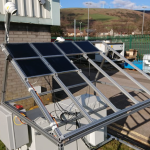
Outdoor Test Facility – Swansea University
Outdoor Testing
- Provides a relatively unique environment for evaluating performance and durability of PV cells and modules in a harsh marine climate
- Exposed to aggressive coastal conditions, offering a valuable testbed for accelerated real-world weathering studies
- Testing Capabilities
-
- Supports both cell-level and module-level measurements
- Devices operated under:
- Maximum Power Point Tracking (MPPT)
- Periodic current–voltage (JV) sweeps
- Current Equipment
-
- Programmable DC loads, capable of testing modules up to 120 V and 30 A
- Typical test protocol: JV sweeps every 5 minutes, followed by holds at maximum power point
- Planned Upgrade
-
- Addition of Undalogic miniSMU MS01 units (up to 12 V and 180 mA)
- Enables high-precision MPPT control for small-area devices
- Environmental Monitoring & Data
-
- Integrated weather monitoring:
- Irradiance
- Temperature
- Humidity
- Wind
- High-frequency data acquisition for both environmental and electrical parameters
- Coastal location + controlled MPPT/JV cycling enables detailed correlation of device performance with environmental stress factors
- Data centrally stored and remotely accessible for analysis and long-term degradation tracking
- Integrated weather monitoring: